
Short answer: when someone tells us "I had HIFU and nothing happened", it is almost always one of three things: you looked too early, the session was not enough, or the energy went to the wrong place. On timing, Hugo Beauty uses only the milestones that appear across this site: no decision about a repeat before month 2–3 of the previous session, and when the previous session did work, one session typically holds for 12–18 months and then fades gradually with age and skincare habits. There is no shorter number, and we will not promise that a second session will work before we know how the first one was done.
This article is written for people in Ho Chi Minh City — long-term residents, people here on a work contract, and visitors who had HIFU abroad or at another studio in Saigon — who paid for a session and are now disappointed. It does not discuss that studio and names nobody. It is about what to do next: whether to wait or be reassessed, how long before you can try again, and what to bring to the reassessment so you do not end up with the same result twice.
First question: how many weeks ago was it?
This is the first thing we ask anyone who comes in saying "I had it done and I see nothing", because most of the answer sits here. Right after the session and for the first 1–2 weeks, the skin feels slightly tighter as old collagen contracts; the real result builds gradually over the following 8–12 weeks as new collagen forms. The result is clearest at month 2–3, once the new collagen has formed. Between those two points — roughly week 2 to week 4 — is the quietest stretch: the early tightness has faded, the new collagen is not yet visible, and this is exactly when many people decide "it did nothing". Our week-by-week HIFU results timeline walks through each stage if you want the full curve.
If you are at week 3, week 5 or even week 7, the answer is: wait. Judging HIFU in a mirror at week 3 means missing most of the result, and we have met people who booked a second session elsewhere at the exact moment the first one was about to show. Repeating during this window does not only waste money; energy added while the previous collagen is still forming does not stack into a bigger result.
How to wait usefully: take photos from the same angle, in the same light, with the same expression — front and both sides — and compare them with your pre-session photos if you have any. If you have none, compare week 4 with month 3. The eye that sees your face every day misses slow change; a photo does not.
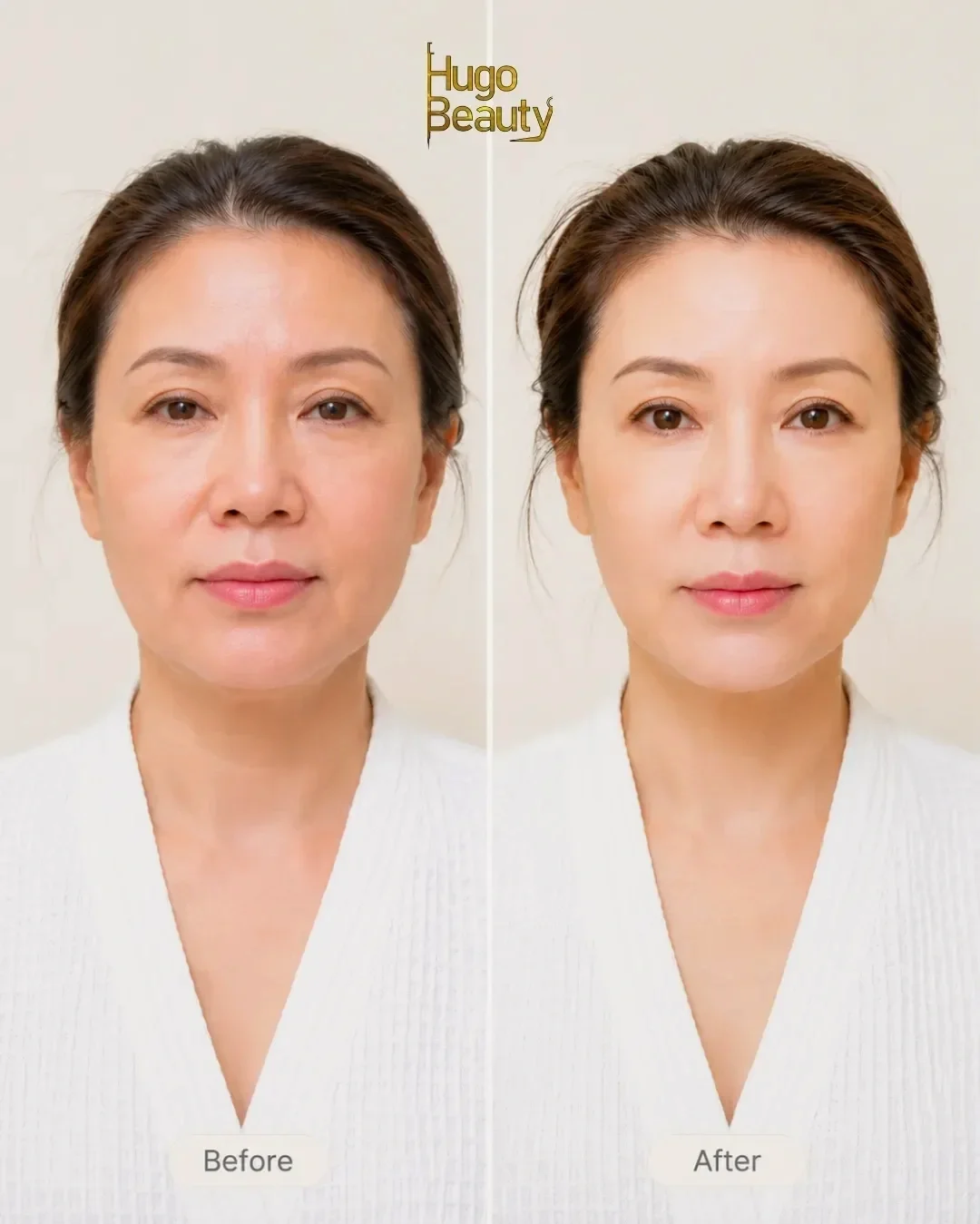
Past month 3 and still nothing: which group are you in?
Once you are past month 3 with same-angle photos that show no difference, the problem is no longer time. Almost nobody is simply "not suited to HIFU"; the cause is nearly always one of three groups — the session was not enough (machine, cartridge, shot count, depth), the right energy went to the wrong place (the area you mind was not the area worked on, or it is fat rather than loose skin), or your body during the three collagen-building months (smoking, rapid weight loss, Saigon sun, poor sleep). The ten specific reasons, with the signs you can spot yourself, are listed in section 3 of our HIFU guide: why HIFU does not work for some people. The table below is the practical version: what you are seeing, what it most likely means, and what to do next.
| What you are seeing | Most likely | What to do next | When to repeat |
|---|---|---|---|
| Only 2–7 weeks in, "nothing" | Too early — the result is clearest at month 2–3, once the new collagen has formed | Wait; same-angle photos at week 4, week 8 and month 3 | No decision before month 2–3 |
| Past month 3, photos identical; no machine name, no shot count, nobody recorded the energy | The session was not enough (machine or cartridge, shots, depth) | Reassessment at a skin check; bring everything you remember | Decided at the reassessment, once the cause is known |
| Past month 3, cheeks a little firmer but the part you mind (chin, neck) unchanged | Wrong priority area, or the double chin is fat rather than loose skin | The pinch test at home; a skin check to see which part HIFU can help | Possibly the missing area — or not HIFU at all, depending on the assessment |
| Past month 3, skin feels thicker but the outline has not moved; a visible fold | The tissue has dropped past what HIFU can gather back | Hear the limits honestly; consider a different route | Repeating usually changes nothing — we will tell you first |
| Rapid weight loss, smoking, heavy sun or poor sleep in those 3 months | The collagen-building base was eaten away | Stabilise weight, sleep and sun protection before thinking about a repeat | Usual milestone: assess only after month 2–3 |
| The previous session worked and has now faded | Normal — one session typically holds for 12–18 months and then fades gradually | Compare today with your month-3 photo from last time | 12–18 months after the previous session, usually a smaller plan than the first |
The two milestones in the last column are the ones used across the Hugo Beauty site. There is no separate "repeat early" milestone — which group you belong to is decided at the reassessment.
How long before you can try again — and why there is no "repeat early" date
This question has two halves. The first is when the previous session worked and has now faded. One session typically holds for 12–18 months and then fades gradually with age and skincare habits. HIFU is usually one session, maintained every 12–18 months, and the repeat is usually smaller than the first — focused on the area that dropped first, such as the jawline or under the chin. That half is covered in how often you should get HIFU.
The second half is the one you are actually asking: the previous session gave nothing, so do you still wait the full 12–18 months, or can you go again now? Hugo Beauty does not set a separate date for this, because the answer depends on the cause, not on the calendar. Two things are certain. First, no decision before month 2–3 of the previous session, because before that point you do not yet know whether it worked. Second, after that point, whether to repeat — and which areas — is decided at a reassessment, after we have looked at your skin and heard how the last session went. If the cause was a session that was not enough, your tissue never received the energy in the right place, so there is no "old result" to wait out. If the cause was the wrong area or tissue past the limit, repeating the same thing gives the same result, and the honest answer may be a different area, or not HIFU.
If your first session was abroad or in another city and you no longer remember which areas or how many shots, our guide for visitors having HIFU in Ho Chi Minh City lists the five things worth writing down after every session.
What we do not say: "a repeat here will work". Nobody can say that before a skin check, and anywhere that does is worth questioning more closely.
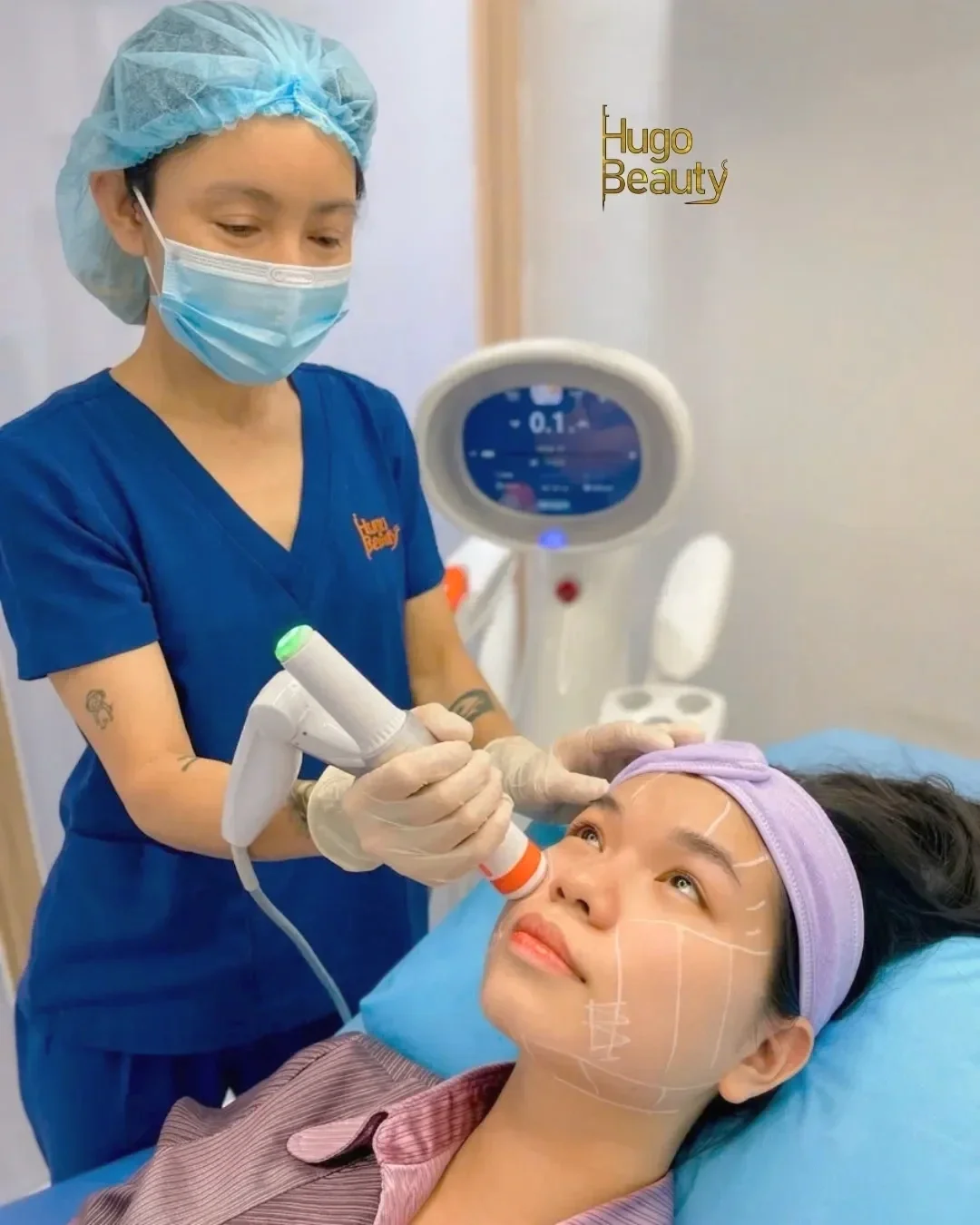
What a reassessment at Hugo Beauty looks like
The skin check is free, takes about 15 minutes, and for someone who had HIFU elsewhere it starts with listening before looking. We ask: when was it; which areas; were you told the machine name; shots per area if you remember; was there a sheet with the energy levels; how long did the session take; and in the three months after, did you lose weight quickly, spend a lot of time in the sun or sleep badly. Only then the looking and feeling: a gentle pinch of each area to tell loose skin from fat, a view straight on and in profile, a comparison with the photos you bring. At Hugo Beauty we use HIFU 10D MPT — a professional HIFU system with 10D MPT technology — and the person who assesses you is the person who holds the handpiece, so what is agreed at the skin check is what is done in the session, and the energy per area is written down so a later session has something to raise, lower or keep.
The reassessment ends with one of three answers, and all three are said plainly: which group the cause belongs to and what a repeat would do differently; the area you mind is not something HIFU can change, so a different route fits better; or wait, because the previous session has not reached its milestone yet. Our page on where to get HIFU in Ho Chi Minh City lists the five things you can verify yourself before paying a deposit anywhere — including here — so that this time you have something to compare rather than an advertisement to trust. One of them is a quick look at the device: why the HIFU machine matters and what to check before you book explains what to ask and why some sessions cost less.
What to bring to the reassessment
Every document from the previous session: the invoice, the session sheet, the chat with the consultant, the package name. Shot counts and depths, if they were recorded, are the most valuable thing; if nothing was recorded, that already tells us something.
Photos: a pre-session photo if you have one, and a current photo from the same angle in the same light. No old photo? A passport photo or a holiday picture from the same year works for comparison.
The date — so we know which week you are in, because that is the question that decides between waiting and reassessing.
Your honest answer to "what did you expect to see, and where": a sharper jawline, a smaller double chin, or just "a younger face". The more specific the expectation, the easier it is to see where the last session went off course.
Your last three months: weight, sleep, sun, cigarettes. Not to judge — to know whether the cause belongs to group 3.
When you are ready, book a HIFU consultation and write "had HIFU elsewhere, want a reassessment" when you book — the studio will allow enough time for the questions. And if the last session happened straight after payment with no skin check at all, it is worth knowing that the feared long-term harms of HIFU almost always trace back to that missing step rather than to the technology itself.
Frequently Asked Questions
I had HIFU three weeks ago and see nothing. Did it fail?
Usually not. Week 2 to week 4 is the quietest stretch: the early tightness has faded and the new collagen is not yet visible. The result is clearest at month 2–3, once the new collagen has formed. Take same-angle photos at week 4, week 8 and month 3 before drawing any conclusion.
HIFU did not work for me elsewhere. How long before I can try again?
There is no separate date for this case. Any decision about a repeat waits until month 2–3 of the previous session; after that, whether to repeat and which areas is decided at a reassessment, depending on why the last session did not work. If the previous session did work and has now faded, the usual gap is 12–18 months.
Would repeating HIFU sooner, every 3–6 months, give a bigger result?
No. Energy added while the previous collagen is still forming does not stack into a bigger result, and it adds sensitivity for nothing. One session, judged at month 2–3, then maintained every 12–18 months, is the pattern we use.
How do I know whether the last session failed because of the machine or because of me?
Bring what you have to a skin check: the date, the areas, the machine name if you were told, shot counts and depths if they were written down, and same-angle photos. A missing machine name and no shot count point to the session; a thick, pinchable layer under the chin or a visible fold points to the assessment; rapid weight loss, smoking or heavy sun in the following three months point to the base. In most cases the cause can be named at that visit.
If I repeat HIFU at Hugo Beauty, is a result certain?
No, and we will not say so before the skin check. What we can promise is an honest reassessment, a named cause, energy levels written down per area, and a clear "not HIFU" if the area you mind is not something HIFU can change.
Related reading
- HIFU results timeline: when will you see them?
- How often should you get HIFU, and how many sessions?
- What happens at a HIFU consultation in Ho Chi Minh City
Message Hugo Beauty with the date of your last session, the areas that were done and one current photo — we will reply on WhatsApp: wait a little longer, or come in for a reassessment, and what to bring.
Message us on WhatsApp